USE CASE TELEMEDICINE
How digital medicine is closing the care gap for rare diseases
How digital medicine is closing the care gap for rare diseases
Innovative telemedicine applications can significantly improve the care of people with rare diseases. A team of doctors at Berlin's Charité hospital is breaking new ground to provide much-needed support to those affected by a neurological disease.
The Supply gap
Rare diseases in Germany
Those affected live in Germany
Rare diseases are known
Days pass on average until the correct diagnosis is made
There are centers for rare diseases in Germany
Many people affected, few experts
„Throughout Germany, there are only a small number of experts who can care for people with the respective rare disease. [...] All this can lead to those affected feeling left alone with their disease and the diagnosis being made after a significant delay. In this respect, digitalization offers [...] a great opportunity for people with rare diseases.“
How can 4 million patients, some of whom have very specific illnesses and live all over Germany, be treated?, supply according to demand?
The Idea
MyaLink: Patient empowerment through telemedicine
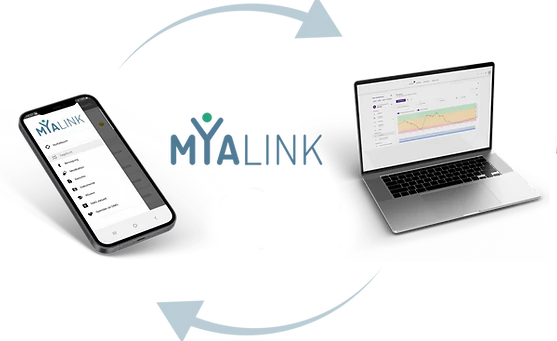
A team of doctors at Charité Berlin is using the innovative potential of telemedicine to provide needs-based care for patients with the autoimmune disease myasthenia gravis from all over Germany. Together with the German Myasthenia Society e.V. and Qurasoft as its technical partner, developed an application called MyaLink, which is based on the telemedical platform SaniQ based.
Myasthenia gravis is a rare, potentially life-threatening autoimmune disease that can affect people of any age. It manifests as fluctuating muscle weakness that can even affect respiratory function. The disease is chronic and requires treatment by specialists.
MyaLink closes the supply gap
MyaLink connects patients in real time with medical specialists at the care center via a patient app, closing the gap in patient care. Telemonitoring of vital signs means that the long periods between appointments are no longer a black box and myasthenia crises can be prevented.
Link to the MyaLink website: www.myalink.de
„We believe that everyone with a rare disease should have access to a specialist!“
Dr. med. Maike Stein
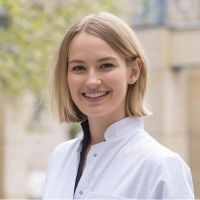
3 questions for Dr. Maike Stein
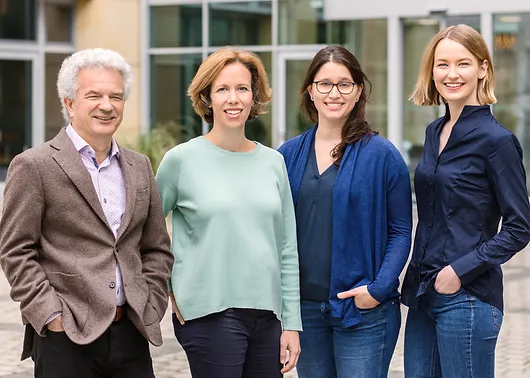
Dr. Maike Stein is a physician and scientist at the integrated Myasthenia Center (iMZ) at Charité Berlin and co-founder of MyaLink. She conducts research at Charité Berlin and Harvard University in Boston with a focus on improving care through digital tools for myasthenia gravis.
Dr. med. Stein:
The idea came about while working in the special outpatient clinic at Charité Berlin. Many of our myasthenia patients - some of whom have to travel several hundred kilometers to come to us - have told us time and again that they have no real contact person for their condition in their home country. At the same time, we don't have the capacity on the medical side to meet patients' needs. Waiting times of several months for an appointment are the rule.
In view of this gap in care, we said to ourselves: We can do better! We believe that every person with a rare disease should have access to a specialist!
Dr. med. Stein:
We are currently evaluating a pilot study that we conducted with 45 patients aged 23 to 83. The patient app was actually very well received by all age groups - we can see that from the data and that was also the feedback we received from the patients.
From a treatment perspective, we see that we can use simple digital communication with patients in the chat to clarify many queries promptly and in line with their needs without the need for personal appointments. Nevertheless, it goes without saying that the app should not replace personal contact, but rather supplement it.
In medical terms, our aim is to use MyaLink to save patients from the intensive care unit by quickly recognizing deterioration and intervening in good time. Telemonitoring of vital signs such as pulse, forced vital capacity and respiratory rate provides the ideal conditions for this.
Dr. med. Stein:
With a telemedicine application like MyaLink, we are to a certain extent breaking new ground in the field of rare diseases. It was important to us that MyaLink is tailored as closely as possible to the needs of patients.
We need a strong partner at our side with whom we can work very closely and trustingly. Qurasoft's technical support is simply worth its weight in gold for us at this point, because we are happy to draw on their expertise and enormous experience in the areas of IT, development, regulatory affairs, etc. This is the perfect complement to our clinical expertise in the field of rare diseases. For us, this is the perfect complement to our clinical expertise in the field of rare diseases.
Dr. med. Stein: The idea came about while working in the special outpatient clinic at Charité Berlin. Many of our myasthenia patients - some of whom have to travel several hundred kilometers to come to us - have told us time and again that they have no real contact person for their condition in their home country. At the same time, we don't have the capacity on the medical side to meet patients' needs. Waiting times of several months for an appointment are the rule.
In view of this gap in care, we said to ourselves: We can do better! We believe that every person with a rare disease should have access to a specialist!
Dr. med. Stein:
We are currently evaluating a pilot study that we conducted with 45 patients aged 23 to 83. The patient app was actually very well received by all age groups - we can see that from the data and that was also the feedback we received from the patients.
From a treatment perspective, we see that we can use simple digital communication with patients in the chat to clarify many queries promptly and in line with their needs without the need for personal appointments. Nevertheless, it goes without saying that the app should not replace personal contact, but rather supplement it.
And from a medical point of view, we have been able to save many patients from the intensive care unit because we can detect deterioration and intervene in good time thanks to telemonitoring. This conserves intensive care capacity and saves money!
Dr. med. Stein: With a telemedicine application like MyaLink, we are to a certain extent breaking new ground in the field of rare diseases. It was important to us that MyaLink is tailored as closely as possible to the needs of patients. It is important that we have a strong partner at our side with whom we can work very closely and trustingly. Qurasoft's technical support is simply worth its weight in gold for us at this point, because it naturally has a great deal of expertise and experience in the areas of IT, development, regulatory affairs, etc. This is the perfect complement for us. For us, this is the perfect complement to our clinical expertise in the field of rare diseases.
The The future
A holistic care model that benefits everyone
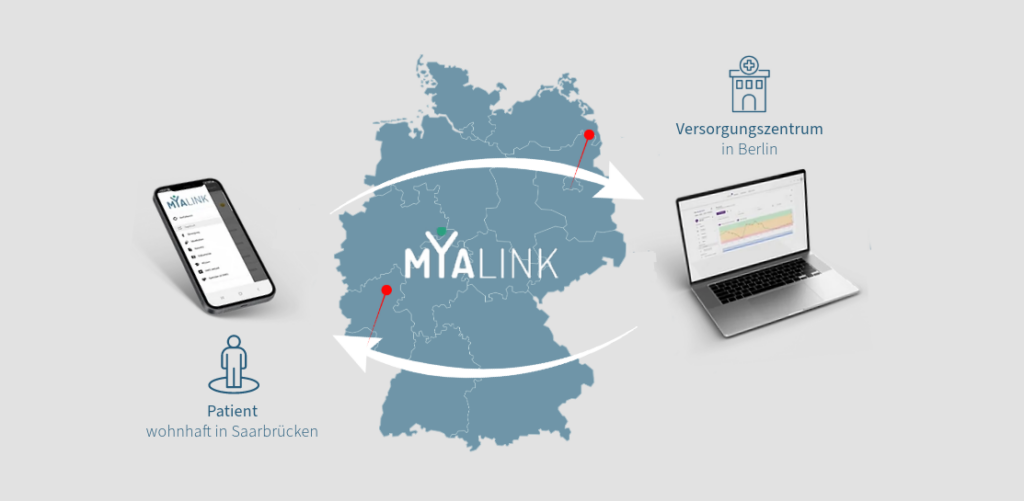
The example of MyaLink shows:
Telemedicine connects people with rare diseases in real time with their highly specialized specialists in sometimes distant care centers.
It enables close-knit remote treatment that benefits everyone:
- Affected parties benefit from specialized and personalized care.
- Doctors receive relevant health data through telemonitoring in order to monitor therapy remotely in a time-saving manner and adjust it if necessary.
- This prevents avoidable crises and intensive care unit stays and leads to immense cost savings in the Healthcare system.

Telemonitoring with SaniQ
SaniQ OS, the basic platform of MyaLink, is a highly adaptable software platform that can be integrated into many scenarios for the telemedical care of people with chronic illnesses.
 Deutsch
  English
  English (UK)
  Français
  Italiano
  Español
  简体中文
简体中文  Nederlands
  Nederlands (België)
  Français de Belgique
  Polski
  Türkçe
  Українська